
Five AI bundles compared: Poe, ChatHub, NanoGPT, Zemith, and AI Fiesta
Paying $20 for ChatGPT and another $20 for Claude adds up quickly. Add an image generator, a video tool, or a website builder, and your monthly AI software bill can become difficult to justify.
That’s why all-in-one AI subscriptions sound appealing. Instead of paying several companies, you pay one provider to access multiple AI models.
But there’s a question worth asking before canceling anything:
Does one subscription actually replace the tools you use, or does it simply give you limited access to more model names?
We investigated five services mentioned in a recent Reddit discussion about replacing separate ChatGPT, Claude, and Qwen subscriptions with a single $10–$20 plan.
Our findings reveal why the cheapest advertised subscription isn’t necessarily the best value.
Research note: This comparison uses published provider pricing, help pages, and policies checked October 11, 2026. We have not conducted hands-on testing of these five subscriptions. Prices, models, limits, and features can change.
The Real Question Isn’t How Many Models You Get
The Reddit discussion began with a familiar request: access to GPT, Claude, and Qwen, preferably for $10–$20 per month.
But the original poster later explained what they actually wanted to accomplish:
- Brainstorm ideas.
- Build websites.
- Generate lots of images.
- Create some videos.
That changes the buying decision.
A subscription that provides excellent access to text models may still be a poor replacement for a dedicated image generator or video editor.
Likewise, having access to Claude through another company’s interface does not automatically mean receiving every feature available in Claude’s own subscription.
Model access and product functionality are not the same thing.
Five All-in-One AI Services Compared
1. Poe: Flexible Access, but Watch the Points
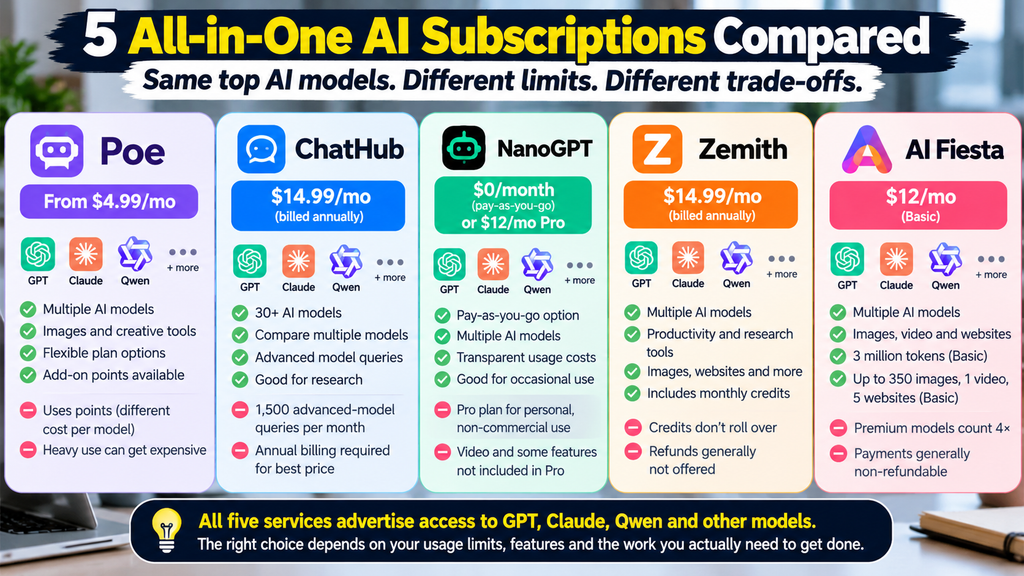
Poe advertises access to models and creative tools from multiple providers, with subscriptions starting at $4.99 per month.
Instead of promising the same number of messages on every model, Poe uses compute points. Each bot or model consumes points according to its rate, and some tasks have variable costs.
That flexibility is useful if you want to switch among models without maintaining several subscriptions.
The catch is that expensive models and media generation can consume your allowance faster than ordinary text conversations. Poe offers additional points for purchase, but that increases your actual spending.
Our assessment: Worth investigating for people who regularly switch models.
Before subscribing, check the point cost of the specific models and creative tasks you expect to use.
Source: Poe purchases FAQ
2. ChatHub: Attractive for Comparing Models
ChatHub advertises access to more than 30 AI models and the ability to compare multiple chatbots.
Its Pro plan is advertised at $14.99 per month when billed annually. The published allowance includes 1,500 advanced-model queries and 3,000 credits per month.
That sounds promising for someone who frequently asks the same question across several models.
But there are two separate considerations: the advanced-model query allowance and the credits used for other activities.
Also, the headline $14.99 monthly equivalent requires an annual commitment.
Our assessment: Worth comparing for text-heavy research and model comparisons.
Check the current monthly billing price and the credit cost of image or video work before treating it as a complete replacement.
Source: ChatHub pricing
3. NanoGPT: Pay for What You Use, but Read the Subscription Terms
NanoGPT offers pay-as-you-go model access and a $12-per-month Pro subscription.
Its pay-as-you-go approach is potentially appealing to someone who uses premium models occasionally rather than every day.
The important distinction is that NanoGPT’s Pro subscription does not automatically include every paid model or feature available through the platform.
Its support documentation identifies separate exclusions for video generation and other paid extras unless they are expressly included in the live plan.
There is another important limitation: its published terms restrict subscription plans to personal, non-commercial use. Commercial users are directed toward pay-as-you-go access.
Our assessment: Worth investigating for occasional, measurable usage—especially the pay-as-you-go option.
If you’re using AI for client projects or a business, check the applicable terms before purchasing Pro.
Sources: NanoGPT pricing, support, and terms
4. Zemith: Broad Features, but Credit Costs Matter
Zemith advertises multiple AI models and productivity tools under one account.
Its Plus plan is listed at $14.99 per month when billed annually. The platform advertises GPT, Claude, Qwen, research tools, and creative features.
That makes it relevant to buyers looking for more than a chat interface.
However, Zemith uses credits, and the cost depends on the model or task. Its published FAQ says included monthly credits don’t roll over, although purchased on-demand credits do not expire.
It also says refunds generally aren’t offered.
Our assessment: Test carefully.
The feature list is appealing, but buyers need to know how much real work their included credits cover before making an annual commitment.
Source: Zemith pricing and FAQ
5. AI Fiesta: One Subscription, but Very Different Media Limits
AI Fiesta advertises a Basic plan for $12 per month and a Pro plan for $29 per month.
The Basic plan includes a published allocation of 3 million tokens per month, but premium models count at four times the normal rate.
More importantly for people who create visual content, the Basic plan advertises up to 350 images, one video, and five websites.
Those figures are advertised maximum allowances, not proof of output quality or suitability for a particular project.
For someone who primarily wants chat and model comparison, Basic might be worth evaluating.
For someone who creates multiple videos every week, an allowance of up to one video is an immediate reason to look more closely before subscribing.
AI Fiesta’s terms also generally make payments non-refundable.
Our assessment: Test carefully for chat; don’t assume Basic replaces a dedicated video workflow.
Sources: AI Fiesta plans and terms

The Hidden Costs That Can Erase Your Savings
A lower monthly price doesn’t guarantee a lower total cost.
There are five costs worth checking.
1. Premium-model usage. Does the service give you enough Claude or GPT access for your actual workload, or will you use up the allowance quickly?
2. Images and videos. Are creative tasks included in the same subscription, and how many finished outputs can you realistically make?
3. Annual commitments. Is the attractive monthly price only available if you pay for a full year upfront?
4. Add-on credits. What happens when your included allowance runs out? Can you wait for renewal, or must you purchase more?
5. Lost workflow features. Will you still have the projects, integrations, editing tools, or specialized capabilities you rely on in the original service?
That fifth cost is easy to overlook. A cheaper model-access service may still require you to keep another subscription for a feature you use every week.
The $40 Subscription Test
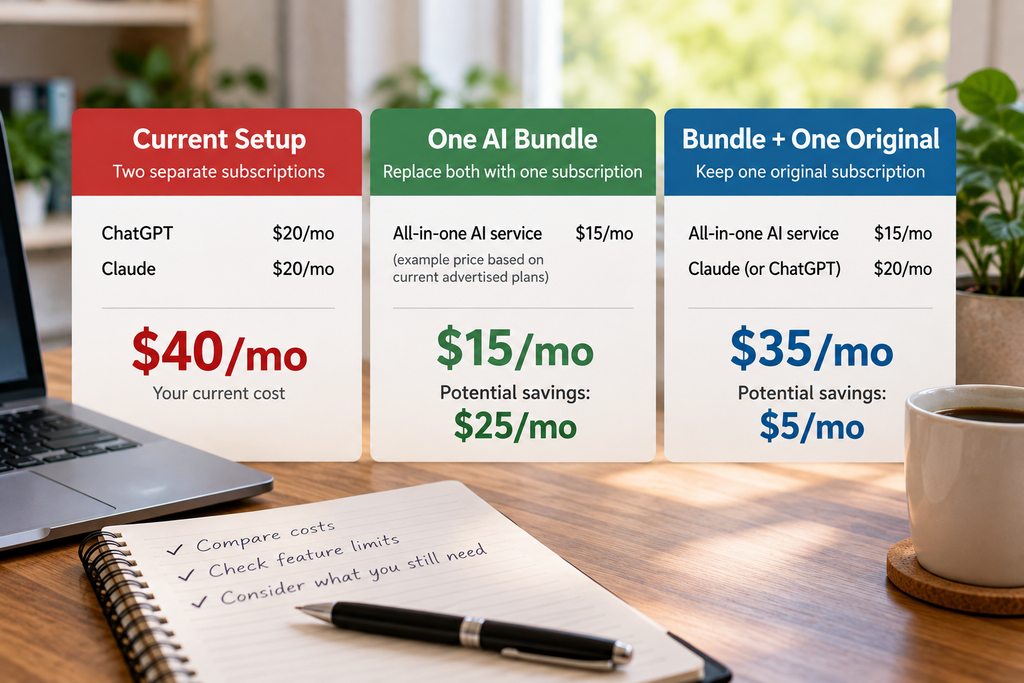
Suppose you’re paying $20 per month for ChatGPT Plus and $20 for Claude Pro.
That’s $40 per month, or $480 per year.
Replacing both with a $15-per-month bundle would appear to save $25 per month, or $300 per year, before considering annual-billing requirements.
But consider three different outcomes:
| Scenario | Monthly spending | Result |
|---|---|---|
| Keep ChatGPT Plus and Claude Pro | $40 | Baseline |
| Replace both with a $15 bundle | $15 | Save $25 if it covers your needs |
| Buy the $15 bundle but keep ChatGPT Plus | $35 | Save only $5 |
These are illustrative calculations, not verified quotes for a specific plan.
And if you then purchase additional credits, a separate video subscription, or another specialized tool, the savings can shrink further.
The real measurement is not subscription price alone.
It’s your total monthly cost for usable results.
Who Should Consider an AI Bundle?
An all-in-one subscription may be a good fit if you mainly brainstorm, research, summarize, write, and compare answers across models.
It may also make sense if you use premium models occasionally and want the freedom to switch without maintaining multiple full subscriptions.
But be cautious if you depend on heavy video generation, high-volume image creation, specific coding tools, integrations, or provider-specific features.
Those buyers need to compare entire workflows, not just model names.
Our Recommendation: Test Before You Cancel
We wouldn’t recommend replacing every AI subscription immediately.
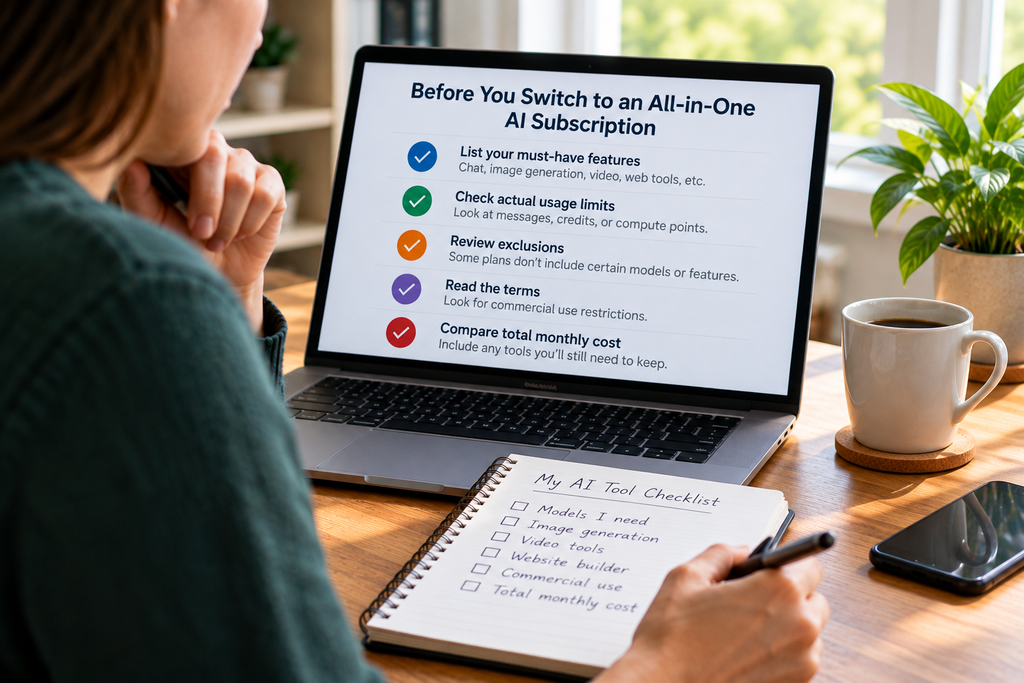
Instead, choose one representative week of work.
Write down what you actually need to accomplish, including how many conversations, images, videos, and website tasks you expect.
Then check whether the candidate service can cover that workload within its advertised allowance.
If a free tier or low-cost pay-as-you-go option is available, use it to evaluate the workflow before making an annual commitment.
Don’t cancel your existing tools until you’ve confirmed that you can finish the same work reliably and at a lower total cost.
The Income Edge Verdict
An all-in-one AI subscription can save money—but only when it replaces work, not merely subscriptions on a billing statement.
Based on the published information:
- Poe deserves consideration for flexible multi-model access.
- ChatHub deserves consideration for comparing models.
- NanoGPT pay-as-you-go deserves consideration for occasional usage with visible costs.
- Zemith requires closer scrutiny of credits and annual commitment.
- AI Fiesta requires especially careful attention to premium-model multipliers and media allowances.
None of these conclusions establishes which platform is fastest, most reliable, or produces the best results. Those questions require hands-on comparison.
If your current AI subscriptions already accomplish your work efficiently, replacing them may not be necessary.
But if you’re paying for overlapping tools you rarely use, this is exactly the kind of spending worth reviewing.
The goal isn’t to have access to the most AI models. It’s to pay the least reasonable amount for the results you actually need.
Get the next answer in your inbox
Each week we research a real question about which AI tools and plans are worth paying for, and we link every source so you can check it yourself.
Free. One email a week. Unsubscribe anytime. Some links on this site may be affiliate links. We always say so, and our recommendations do not depend on them.