
ChatGPT Plus vs Pro is a decision more subscribers face when they start hitting usage limits. The obvious fix seems to be upgrading, but is paying more actually worth it?
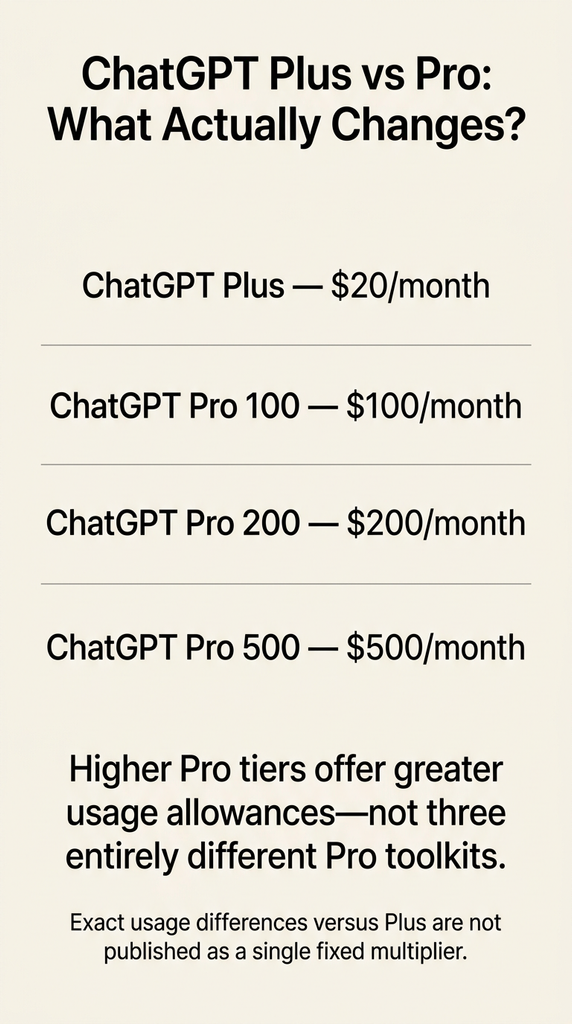
But Pro is no longer just one plan. OpenAI now offers three Pro tiers at $100, $200 and $500 a month. The difficult part is comparing their usage allowances with what you actually need.
And the question that matters most before paying five to twenty-five times more is this: How much additional useful work will the upgrade actually let you finish?
OpenAI publishes some usage estimates and feature differences, but not one universal Plus-to-Pro usage multiplier that answers that question for every workload.
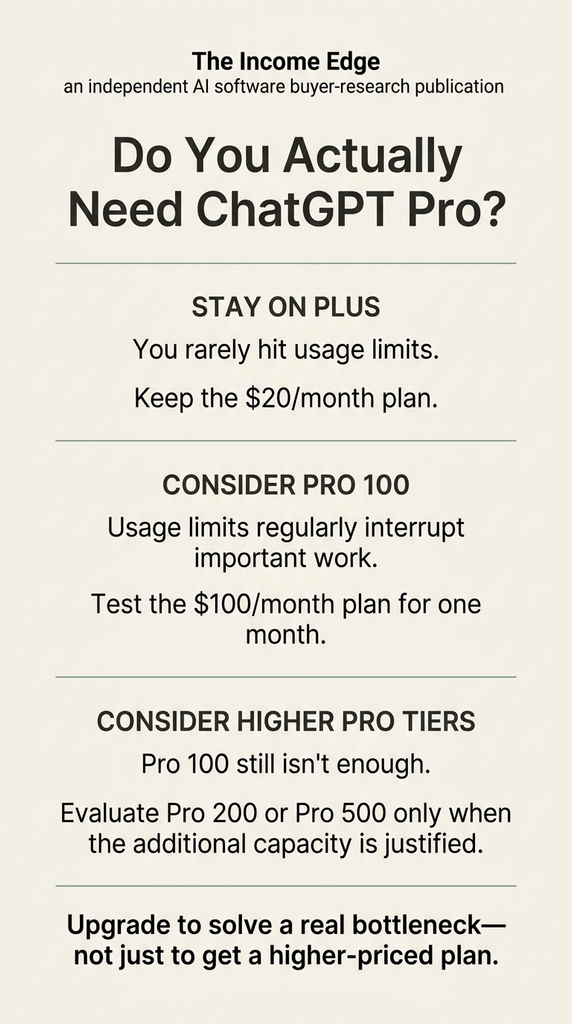
Short answer: If you only hit Plus limits occasionally, staying on Plus is probably the better decision. If recurring limits interrupt valuable work, a one-month Pro 100 test may be worthwhile. Pro 200 and Pro 500 require a much stronger justification.

What $20 Plus actually gets you
According to OpenAI’s ChatGPT Plus help page, Plus costs $20 per month and includes priority access during busy periods, higher model limits, faster responses and expanded access to tools.
But Plus doesn’t provide one fixed usage allowance that applies to every model or task.
OpenAI says Plus may have message caps, particularly during high demand, and those limits can vary with system conditions.
OpenAI also publishes estimated usage ranges for certain Work and Codex activities. Those estimates are not guaranteed message counts, however, and the amount of work completed can vary considerably.
That matters for the upgrade decision.
A difficult week on Plus doesn’t automatically mean you need Pro. You may have used a more demanding model, processed larger documents, or run tasks that consumed more of your allowance than usual.
Before spending more, you need to know what actually caused the interruption.
ChatGPT Plus vs Pro: Compare the Four Plans
OpenAI’s Pro tiers help page confirms three monthly plans.
| Plan | Monthly price | Included usage | Ultrafast |
|---|---|---|---|
| Plus | $20 | Limits vary by model and activity | No |
| Pro 100 | $100 | Entry-level Pro allowance | No |
| Pro 200 | $200 | More than Pro 100 | No |
| Pro 500 | $500 | Highest included Pro allowance | Yes |
All three Pro tiers include access to Pro models, Codex, deep research, image creation, memory and file uploads.
The differences are primarily the included usage allowance, price and availability of Ultrafast.
There are two important details worth understanding.
First, Ultrafast consumes included usage more quickly.
For eligible models, OpenAI says Ultrafast consumes included usage at eight times the Standard rate. Faster responses can therefore use up your allowance more quickly.
Second, buying additional credits on Pro 100 or Pro 200 does not unlock Ultrafast.
OpenAI currently reserves that option for Pro 500.
There is another distinction worth knowing: Pro 100, Pro 200 and Pro 500 currently have no five-hour usage limit in Work and Codex, but each still has an included usage allowance.
That does not mean unlimited access to every model or feature.
Source: OpenAI — Managing usage with GPT-6 Astra in Work and Codex
What changes when you upgrade?
OpenAI’s ChatGPT pricing comparison lists several differences between Plus and Pro.
For example:
- Standard/Instant chat context window: 54K on Plus versus 128K on Pro.
- Maximum input for standard chats: Approximately 40 pages of text on Plus versus 250 on Pro.
- Reasoning context window: 256K on Plus versus 400K on Pro.
- Codex: Available on Plus, with expanded access and longer sessions on Pro.
Those figures describe context capacity and feature access. They don’t tell you how many messages or tasks your subscription will cover before you reach a usage limit.
A larger context window can help when you’re working with substantial documents or complicated conversations.
But if your main problem is running out of allowance, a larger context window alone doesn’t prove that the upgrade is worth paying for.
What OpenAI doesn’t tell you
Here’s the biggest gap in the buying decision.
OpenAI confirms that Pro 200 includes more usage than Pro 100 and that Pro 500 offers the highest included usage.
But it doesn’t provide one universal Plus-to-Pro usage multiplier that tells every buyer how much more work a subscription will cover.
That makes a straightforward comparison difficult.
If you’re paying $20 and regularly reaching your limit, you cannot reliably calculate how many additional completed tasks the $100 plan will deliver from the subscription price alone.
Your results depend on the models, tools and workloads involved.
That’s not necessarily a reason to avoid Pro.
It’s a reason to treat your first month as a measured test rather than assuming a more expensive subscription will automatically solve the problem.
An October 29 deadline for some Pro 200 subscribers
There is also a time-sensitive change affecting certain existing Pro 200 subscribers.
According to OpenAI’s Pro tiers documentation, people who had an active Pro 200 subscription at any point from September 22 through 10 a.m. Pacific Time on September 29, 2026, qualify to keep their previous included usage allowance through October 29, 2026, while their Pro 200 subscription remains active.
After October 29, their allowance moves to the newer, lower level.
The monthly price remains $200.
That means some existing subscribers will receive less included usage while paying the same monthly price.
If you’re affected, check your usage after the change before assuming your subscription still delivers the same value.
Before you pay $100: a one-month test
The Income Edge’s approach to software subscriptions is simple: make the additional expense prove its value with your actual work.
Here’s how to evaluate the upgrade.
1. Track your Plus limits for one week.
Record how often a limit interrupts you and what you were doing at the time.
Was it ordinary chat, a long document, coding, image creation or a more demanding research task?
Also record how long the interruption lasted and whether it prevented you from completing something important.
2. Check what caused the limit.
OpenAI explains that usage depends on factors including model selection, context, reasoning, tools and speed mode.
Check your account’s usage information and reset times where available.
Source: OpenAI — Work and Codex pricing and usage
You may discover that one particular kind of work consumes much more allowance than everything else.
3. Consider Pro 100 for one month if interruptions continue.
If recurring limits are preventing you from completing valuable work, Pro 100 may be worth testing.
Keep the same usage log during the trial month.
4. Compare the results.
At the end of the month, ask:
- Did the interruptions decrease enough to matter?
- How much productive time did the upgrade actually recover?
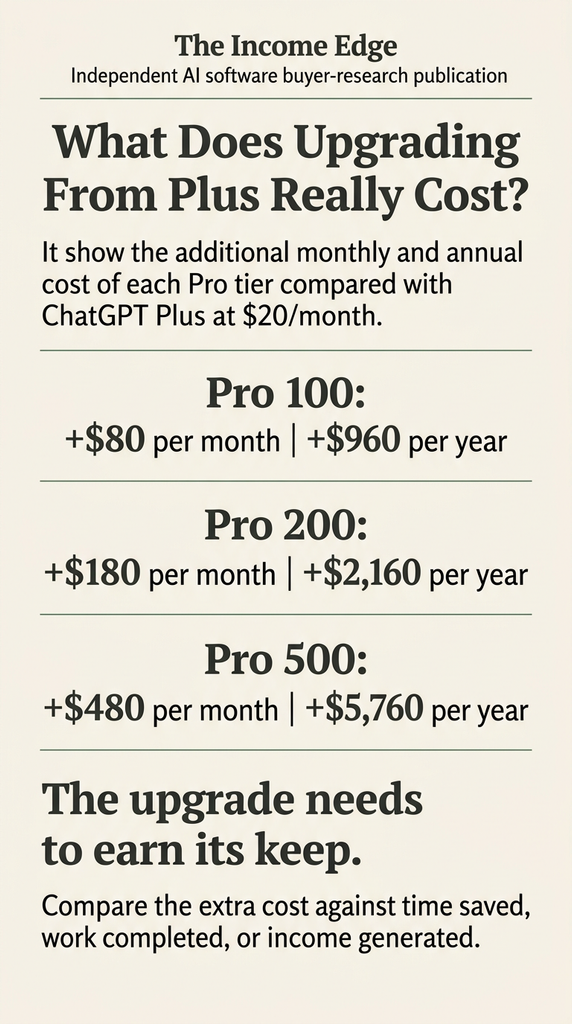
- Was that recovered time worth the additional $80 per month?
- Did you use the extra capabilities, or did you mainly continue doing the same work?
5. Only consider a higher Pro tier if necessary.
If Pro 100 solves the problem, there’s no reason to pay $200 or $500 simply because those plans are available.
And if Pro 100 doesn’t deliver enough value to justify its price, the right answer may be to return to Plus rather than upgrade again.
The same principle applies when evaluating specialized AI tools. Our guide to when a specialized AI tool is worth paying for explains how to judge whether the additional cost delivers meaningful value.
Verdict: Which ChatGPT subscription is worth it?
Stay on Plus at $20 per month if you hit limits occasionally, primarily use ChatGPT for everyday work, or cannot identify a meaningful financial benefit from upgrading.
Consider Pro 100 at $100 per month if recurring limits interrupt valuable work. Test it for one month and compare the time recovered against the additional $80 monthly cost. Don’t upgrade solely because Pro offers a larger context window.
Consider Pro 200 at $200 per month only if Pro 100 still restricts work that justifies the additional expense.
Consider Pro 500 at $500 per month only if your workload supports that cost or you specifically need its Ultrafast capabilities. Remember that Ultrafast consumes included usage at eight times the Standard rate for eligible models.
One additional consideration: OpenAI offers purchased credits for certain eligible features, which may be worth comparing with a permanent plan upgrade when your extra usage is occasional. Credits do not extend every ChatGPT feature.
Source: OpenAI — Using credits for flexible usage
The cheapest upgrade is the one you can prove you need.
A more expensive AI subscription isn’t automatically a productivity improvement. The real measure is how much useful work you finish, how much time you recover, and whether those benefits exceed what you’re paying.
How we reviewed this: The Income Edge reviewed OpenAI’s official ChatGPT Plus, Pro tiers, pricing and usage documentation on October 20–21, 2026. We have not subscribed to or hands-on tested the Pro tiers. Prices, features and usage allowances may change. We are not affiliates of OpenAI. AI assisted with research and drafting, with human editorial review before publication.
Get the next answer in your inbox
Each week we research a real question about which AI tools and plans are worth paying for, and we link every source so you can check it yourself.
Free. One email a week. Unsubscribe anytime. Some links on this site may be affiliate links. We always say so, and our recommendations do not depend on them.